
.png)
.png)
China vs Japan: The Untold Story of Matcha’s Birth
- Dec 4, 2025
- 6 min read

MATCHA - A CHINESE MOTHER, A JAPANESE FATHER?
In a moment when global attention turns toward the escalating tensions between China and Japan - two ancient Asian civilizations whose histories have intertwined and influenced one another for thousands of years - I wishes to tell a much smaller story, as delicate as a dusting of tea, yet carrying the full depth of culture: Where does matcha truly come from?
This question does more than trace the lineage of tea processing. It reflects how each nation shapes its identity: one gave birth to the technique, the other perfected the spirit. And the journey of matcha, when examined closely, is a distilled portrait of that very transmission.
This article will guide you along that path: from its Chinese beginnings in the Tang and Song dynasties, to its rebirth in Japan, while highlighting the technical distinctions between Chinese and Japanese matcha as we know them today.
1. Powdered Tea in Chinese History:
Where the Story Begins
Historical records note that mo cha (powdered or dusted tea) emerged during the Tang dynasty, but it reached its pinnacle of aesthetic refinement in the Song dynasty (960-1279).
Song-Dynasty Powdered Tea - The Height of the Dian Cha Fa (點茶法)
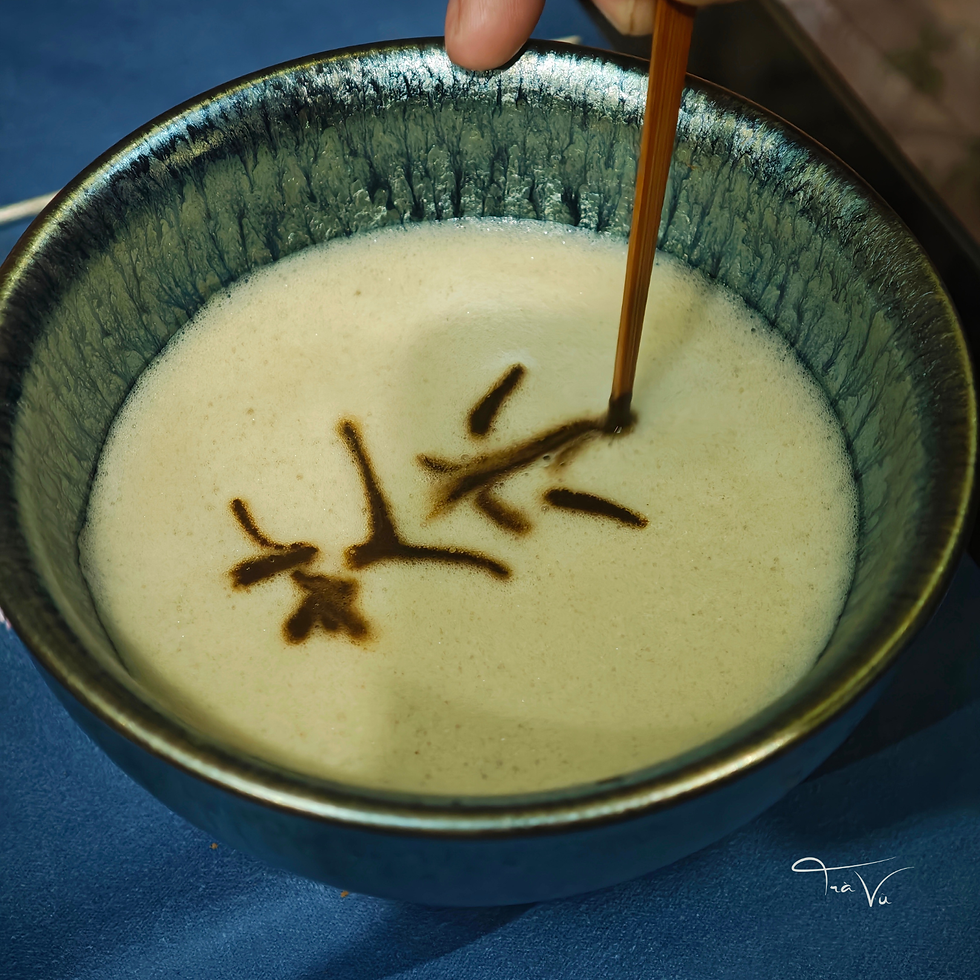
In the Song era, tea leaves were processed into compressed cakes (tea bricks), then ground into powder, sifted finely, and whisked into a foamy surface using a bamboo whisk. The practice of Dou Cha (鬥茶) or ming zhan (茗战) - tea-whisking competitions that judged the beauty and stability of the foam - became a beloved pastime of court society and the literati.
Several notable documents illustrate this tradition:
The Taiping Huanyu Ji (10th century) clearly records the regions famed for producing tea cakes.
The Treatise on Tea (Da Guan Cha Lun) by Emperor Huizong of Song (1100-1126) offers detailed descriptions of steaming the leaves, pressing them into cakes, grinding them into powder, and whisking them into foam - a process strikingly similar to modern matcha techniques.
The dark-glazed ceramics of Chaozhou and Jian ware were favored because their deep tones accentuated the whiteness of the tea foam - much like the Japanese preference for dark-glazed chawan to enhance the visual contrast of matcha.
In essence, this was the true precursor to matcha. It is for this reason that I often refer to China as the mother of matcha, long before its fame crossed the borders and took on new life elsewhere.
Why Did China Abandon Powdered Tea?
By the Ming dynasty (1368-1644), Emperor Zhu Yuanzhang issued an imperial decree banning the production of tea cakes, forcing all regions to shift toward loose-leaf tea. This marked a pivotal turning point:
The culture of powdered tea disappeared.
The skill of whisking tea foam gradually faded.
Brewed loose-leaf tea became the new standard across China.
Meanwhile, in Japan, the journey of powdered tea took an unexpected turn...
2. Japan - Where Matcha Was Reborn and Refined
Matcha Enters the Monastic World
In the 12th century, Zen monk Eisai (1141-1215) traveled to China to study Chan Buddhism. He returned to Japan with tea seeds and the knowledge of powdered-tea preparation. In his work Kissa Yojoki (Treatise on Tea for Health), he praised powdered tea as a drink that sharpened clarity of mind and body during meditation.
Powdered tea found a home and flourished within:
Zen monasteries
The aristocracy
The warrior class in later generations
Japan not only preserved the technique of powdered tea, but it also transformed it into a ritual practice. From this evolution emerged Chado - the Way of Tea.

Sen no Rikyu and the Philosophy of Wabi-sabi
In the 16th century, Sen no Rikyu brought matcha to its most minimalist and profound expression. The philosophy of wabi–sabi–simplicity, stillness, and the beauty of imperfection – became the spiritual core of Japanese tea culture.
From that point on, matcha was no longer merely a way of drinking tea. It became:
A way of life
A lens through which beauty is perceived in incompleteness
A moment of presence elevated into ritual
If China gave matcha its “body,” Japan bestowed upon it its “spirit,” allowing the world to discover it through the art of the Tea Ceremony.
Yet it was not only the ritual that changed; the Japanese also transformed the production methods, creating distinctions that set their matcha apart from China’s powdered teas.
3. Japanese Matcha Craftsmanship -
The Global Standard
To understand why Japanese matcha is considered the benchmark, we must examine the precision at every stage of its production.
Shading the Tea Plants for 20-30 Days
Shading increases chlorophyll and L-theanine levels, resulting in a deeper green color, dense umami, and reduced bitterness. This single step distinguishes tencha (the raw material for matcha) from all other green teas worldwide.
Steaming to Halt Oxidation
Steaming preserves color and fresh aroma, preventing oxidation – a sharp contrast to China’s pan-firing methods.
Removing Stems and Veins
Only the tenderest leaf material is kept, ensuring a silky texture and natural sweetness.
Grinding with Granite Millstones
Extremely slow grinding
Only 30-60 grams per hour
A particle size of approximately 5-10 microns
This meticulous process gives Japanese matcha its characteristic cream-like viscosity and smooth, clump-free finish.
Clearly Defined Quality Grades
Ceremonial Grade – used in formal tea ceremonies
Premium Grade – high-quality daily use
Culinary Grade – for beverages, cooking, and desserts
Together, these elements form a new global standard that the world now recognizes simply as Matcha.
4. Chinese Matcha Today: Revival or Imitation?
As matcha rose to global prominence, many regions in China began producing powdered tea once again. Yet two entirely different categories emerged:
Industrial Tea Powder – the majority of the market
No shading or only minimal shading
High-speed machine grinding
Yellowish-green color
Sharp bitterness with little umami
Primarily used in matcha lattes and ready-made beverages
This is not matcha in the traditional sense.
High-grade Matcha-Style Powder
Some regions, such as Zhejiang and Sichuan, now produce tea powder using techniques similar to Japanese matcha:
Shading is applied, but typically only for 7-15 days
A fresh green aroma, but lacking the distinctive umami sweetness
Fine particle size, though not achieving Japan’s creamy viscosity
Flavor leans toward grassy and refreshing, with less of the oceanic depth and richness
Although the quality has improved significantly, the result remains more of an emulation than a true identity of its own that could be called “Chinese Matcha.”
Within the professional community, this category is referred to as “Chinese Matcha-Style Green Tea Powder,” a term that honors the technique while acknowledging the differences in character.
5. Japanese Matcha vs. Chinese Matcha:
Where Do They Differ?
Philosophical Differences
China: technique, visual appreciation, craftsmanship.
Japan: meditation, mindfulness, wabi-sabi, ritual.
Cultivation Differences
China: mostly unshaded or lightly shaded
Japan: shading is mandatory for 20-30 days
Flavor and Aroma Differences
Japanese Matcha:
Rich umami
Low bitterness
Creamy, dense texture
Oceanic, milky, fresh-green aroma
Chinese Matcha:
Light, grassy flavor
Noticeable bitterness
Low creaminess
Minimal lingering sweetness
4. Differences in Production Standards
Japan: rigorous, traditional, consistent
China: highly varied – from industrial to premium – but lacking uniform standards
So, Who Does Matcha Belong To?
From a historical perspective:
China is the birthplace of powdered-tea techniques.
Japan is the guardian and perfectionist of those methods.
From a cultural perspective:
Matcha became a national symbol only after entering the Japanese Tea Ceremony.
In China, powdered tea remains a chapter of the past rather than a living tradition.
From a market perspective:
Ninety percent of the world’s high-quality matcha comes from Japan.
China dominates in industrial-grade powdered tea.
And from the perspective of a simple tea drinker – as I see myself – matcha is a joy, not a competition.
7. The Journey of Matcha Across Two Civilizations
Matcha, in its modern sense, could not exist without:
The powdered-tea processing techniques of ancient China
The Zen philosophy and wabi-sabi aesthetics of Japan
The meticulous refinement of contemporary Japanese craftsmanship

One side gave matcha its roots, like a mother. The other nurtured it, like a father. And the tea leaf itself remains quietly in the middle – unburdened by division – allowing us to continue telling new stories about it. It is a story of transmission, continuity, and rebirth.
When we lift a bowl of matcha to our lips, perhaps what we drink is not merely green tea powder dissolved in water, but the shared heritage of two cultures, carried across a thousand years, meeting one another in the stillness of the present moment.
********
Last updated: 04/12/2025
Trà Vũ 舞茶 - Trà nhân, người kể chuyện trà.
Teaist Blog - "Tea Flows, Stories Unfold"
Comments